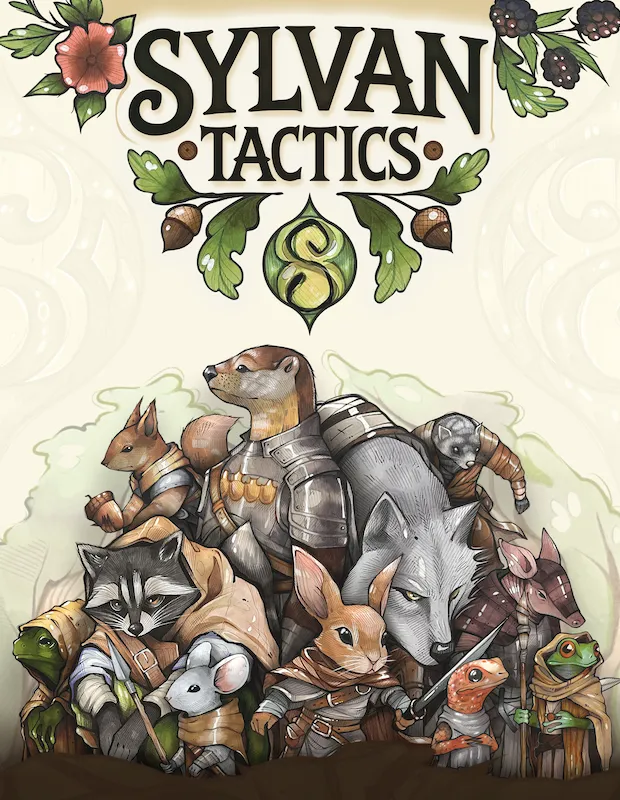
Bringing Chess to Life in Sylvan Tactics
Gil: Hey Tyler, welcome to the Dextrous Designer spotlight!
Tell us about yourself as a game designer - how did you get started making games and what game/s are you working on now?
Tyler: I started making games years ago with a few simple tabletop games that I played with my friends and family. I even published one as a print-and-play (don’t try to look it up… it’s not good), but I always felt that my career goal was to become a video game designer. I tried that for a few years as an indie game developer and even got a few published on Steam, but ultimately I determined that it wasn’t financially viable in the long term.
I transitioned to a career in web development while still working on small hobby projects in my free time. When I was laid off from my job in 2023 I realized that I had a unique opportunity to really dive back into tabletop game development. I was somewhat disillusioned by software development and wanted to get away from a computer screen. I wanted to build something physical. Something that would help me connect with friends and family again like I had years ago.
So I started working on Sylvan Tactics. It’s a card-battling game that uses a standard chess board and pieces for positional strategies. I’ve since found work again in web development, but Sylvan Tactics has had such a great response from players that I’ve been committing a lot of personal time to try and turn it into a commercial product. Despite the long hours and many logistical challenges, I still have a ton of passion for the project. I’ve even started building a digital version of the game which you can check out.
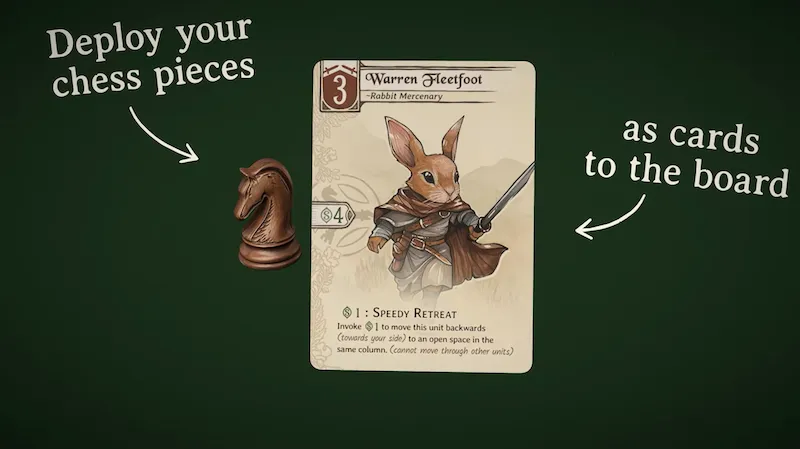
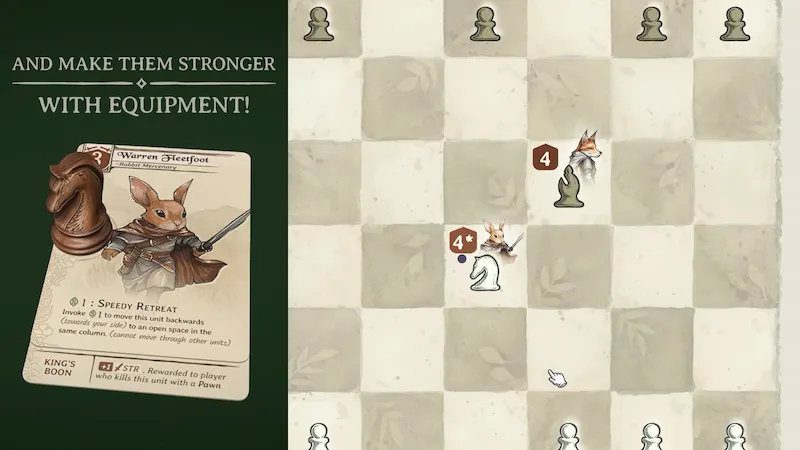
Gil: Ok wow so it sounds like you’ve had a journey with twists and turns but it sounds like your skillset allows you to bridge the digital and analog worlds in interesting ways. Tell us more about Sylvan Tactics, I’ve been vaguely following its development and it looks super interesting. Card battling + chess sounds like a pretty unique combo. How did you come up with the idea for it and what’s driving the passion you have for it?
Tyler: I had just gotten back into playing Magic: The Gathering after quitting about 13 years prior. I found a new group to play with which was really important for me. I’m not the type to go play in tournaments at game stores against strangers. With the development experience I had gathered over the last decade I began to look at every MtG card with more of a design-lens than I did back then. I was getting excited about the design space that each set was trying to cultivate.
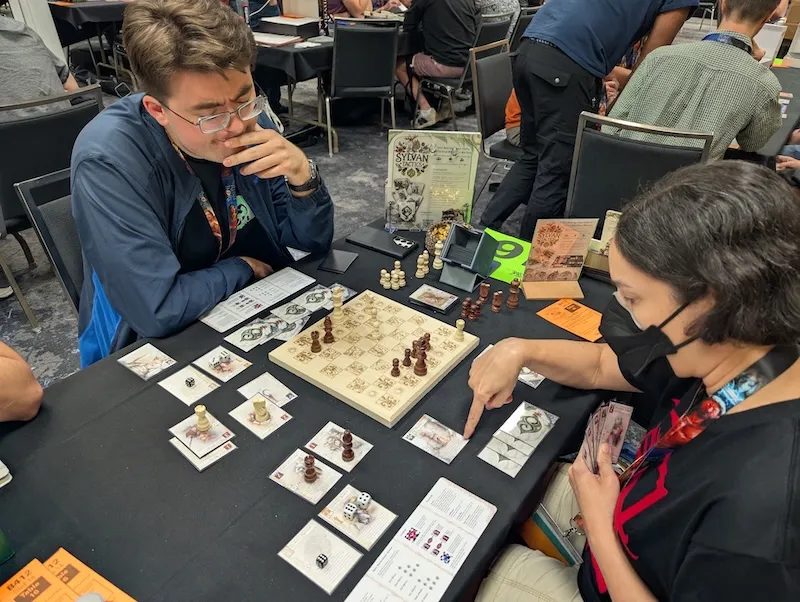
I still love the game, but my mind started to wander to “what if” questions that made me realize I would probably really enjoy designing a game that borrows some of my favorite parts of MtG while adding other elements that I think could benefit the card-battler genre. Most importantly: the idea of adding positional combat where your cards are represented by units on a board. This isn’t a completely original idea, but I also knew that it had not been done in a way that satisfied my vision for how it could work.
Gil: Ok right yes this is super relatable: so you were like, ‘I love MtG, but I want more positional dimensions’ type thing?
Tyler: Exactly, and at the same time, I was pondering the feasibility of publishing a board or card game. I have released digital games, but those are much “simpler” when it comes to publishing logistics. I was worried that physical manufacturing and distribution would be a huge barrier. I began looking at this as a design challenge. How could I design a game with dozens of unique cards, a board, and pieces in a way that is reasonable to playtest and cost effective to manufacture? In the past I had used boards and pieces from other existing games during playtesting, but always with the intent to replace them with “real” pieces later. But that got me thinking… What if the game intended for you to use boards and pieces you already own? And what game do many people already own? Chess seemed like the perfect fit.
So I began designing Sylvan Tactics with that “innovation through limitation” constraint. The pitch is “just add this deck of cards to your existing chess board and you are playing a completely different game”. So far that idea seems to be resonating with people. Especially when so many people are also very price-conscious with their hobby spending currently. I can provide a mechanically-complex experience with a very low cost set of components. Just a deck of cards.
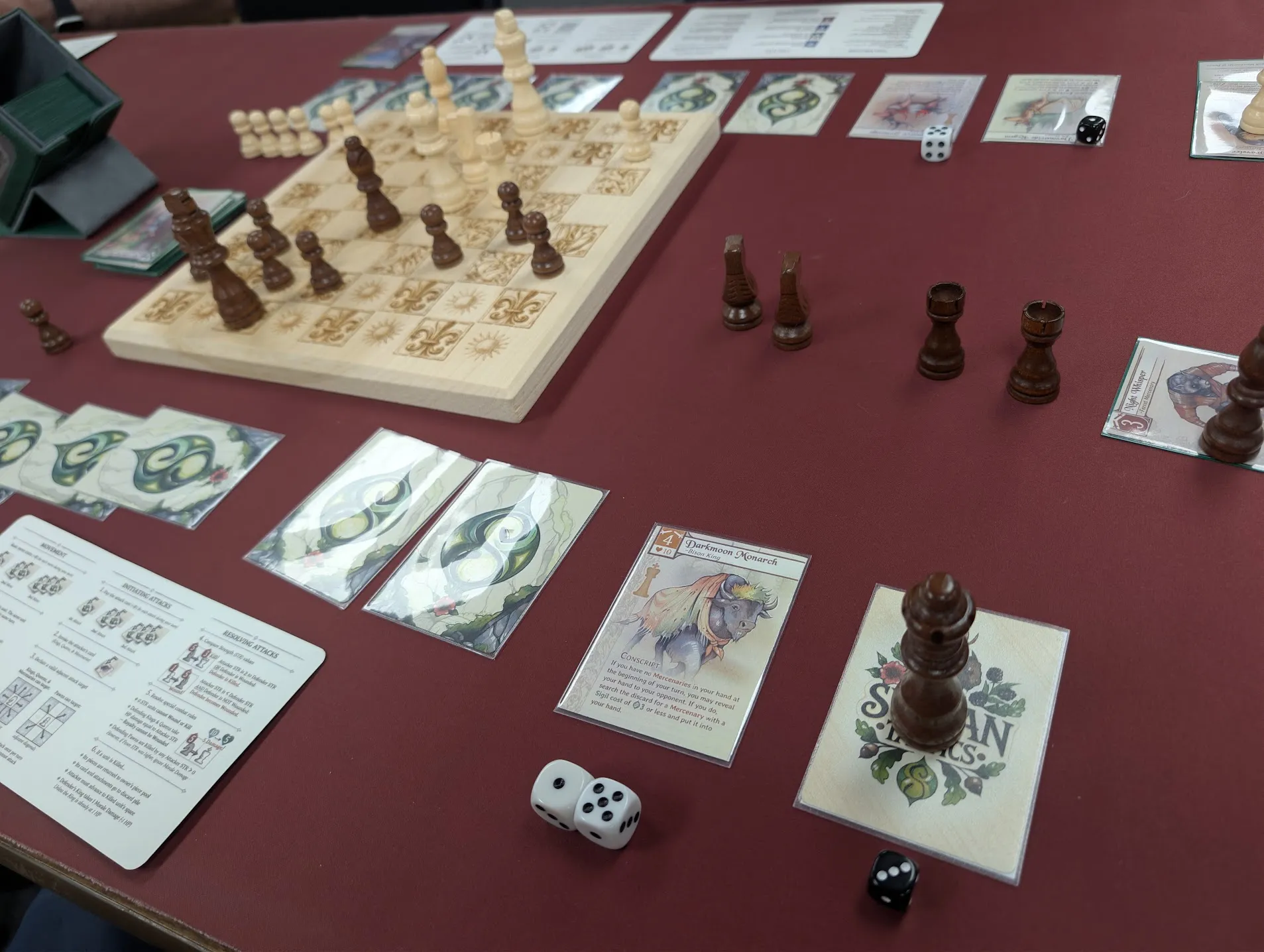
Gil: Ah wow yes I see - that’s a clever pitch indeed. So you’re able to produce something at a much cheaper price and you don’t have to necessarily make your own moulded miniatures. And to players it’s kind of like a ‘level up’ on something they might already own and love. This is very savvy thinking!
Tyler: I also jettisoned the idea of it being a TCG very early on to reduce the amount of art I would need to produce. With a shared deck between both players it really becomes more of a MtG-inspired board game. In the end I think we will have about 80 unique cards in the base game with the potential for later expansions to build out the card pool for more variety. This model might make it closer to a “Living Card Game” or “Expandible Card Game”, but ultimately I don’t think that does it justice either. The positional element of the chess board makes every game different even if you happen to draw many of the same cards each game.
I probably would have slowly chipped away at the idea for years, but when I hired an artist to test out a potential art style and theme I knew we had something special. The game uses Redwall-inspired anthropomorphic creatures for the units and it feels magical. That is what is really pushing me to make this game a real product that people can hold in their hands. Our artist (@kkkalinina.art on Instagram) is doing such a beautiful job bringing the project to life and I am just so excited to show it to people every chance I get.
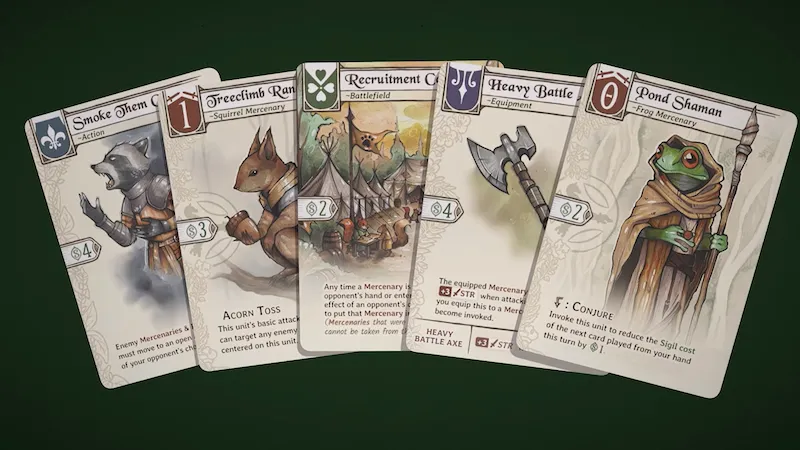
Gil: 100%. I’m a big redwall fan from way back and have read easily 8-12 of the books, so this art feels quite close to home in a way (who doesn’t love seeing mice and squirrels wield weapons right?!). But on the other hand, I actually think the layout design is quite unique and the aesthetic is really distinctive. How did you settle on the card layout and visual exactly? Were there any challenges you had to keep in mind in terms of form vs function?
Tyler: The design inspiration comes from two main sources. The first was children’s books and fairy tales. The art on top and the story text on the bottom. Of course, this is already a very common layout, but I think when you apply that storybook aesthetic it really invokes this timeless, classic quality. I really wanted to avoid a card layout that had distinct boxes. Bordered boxes feel much more modern like infographics or comic books. Obviously, you can’t completely avoid boxes. You still need to define space for each piece of information, but I felt like it was important for those spaces to breathe and naturally flow into each other. So I don’t really have many borders or dividers.
The second inspiration came from nature journaling which my wife does all the time. She will take hikes and then paint little watercolor illustrations of the plants and animals she encounters with little handwritten descriptions beside them. These are often done on paper that is slightly off-white and so that is the base color we use for all the card backgrounds. And since all our artwork is actually hand illustrated on paper, it really makes it all feel very cohesive and consistent.
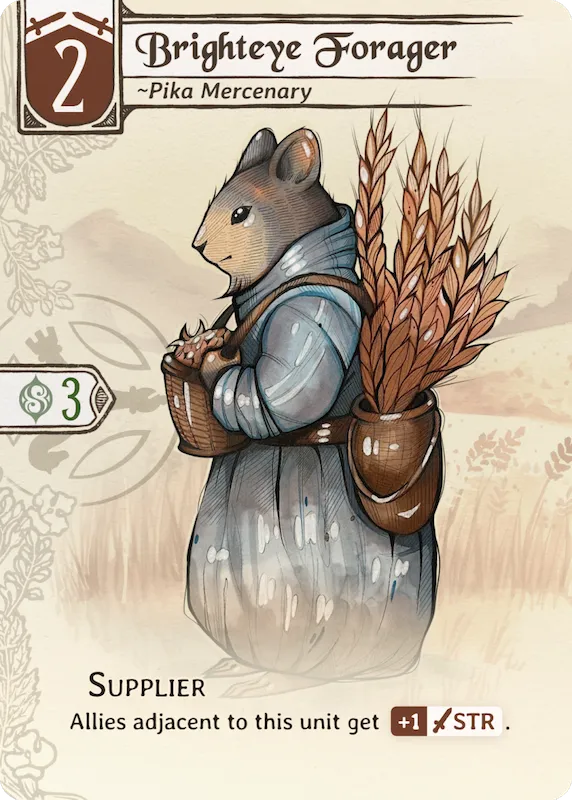
It doesn’t feel digital even though a lot of digital manipulation is happening to merge the illustrations with the card text and iconography.
Gil: Yeah fantastic, I think you can really see the cohesive styles coming together in a really satisfying and beautiful way. You mentioned digital manipulation which makes me curious. What is your tech stack at the moment and what role does the digital world play in your design process? I know you’ve tried a whole bunch of tools and workflows and platforms - how does Dextrous fit into that?
Tyler: We are really committed to a certain level of aesthetic authenticity when it comes to the artwork, and to me that means using more traditional mediums in order to emulate that storybook quality we are looking for. I think even when you are digitally recreating traditional art styles it’s still subtly noticeable that the images were created on a computer and not on paper or a canvas. So our commissioned artist has been illustrating all of our featured card art with her unique style in watercolor and acrylic markers. These are high contrast, colorful images that really pop, but they have that almost imperceptible analog noise or texture to them that is captured quite nicely with a high-quality scanner.
Then I will begin a rough layout to position the character or subject of the artwork with the text of the card to ensure that the important parts of the art are not covered by any text. This is done in Photoshop, but is only for mockup purposes because we are not quite done yet with the artwork. The next step is to provide that positioning mockup to my wife, Frances, who is the artist for all of our background artwork. Background art is only produced for our Mercenary cards which feature the Redwall-inspired animals as the main artwork. She does this with traditional watercolors which are then also scanned and digitized.
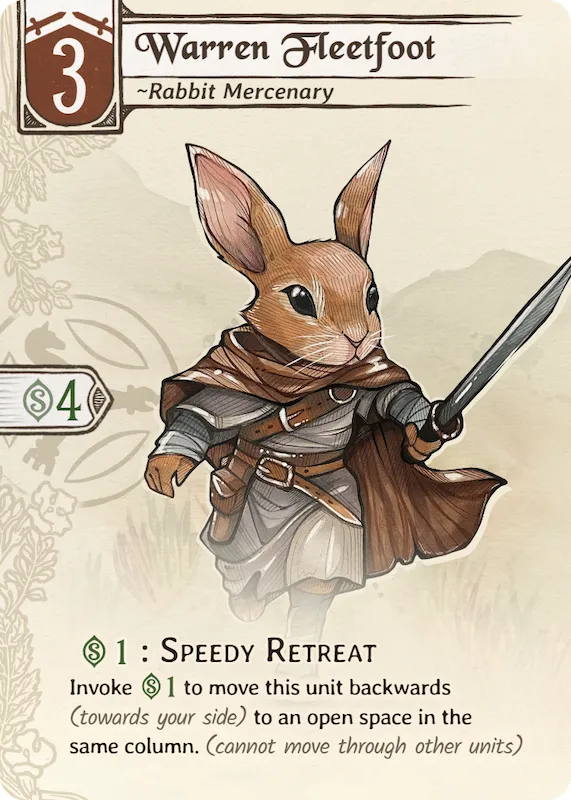
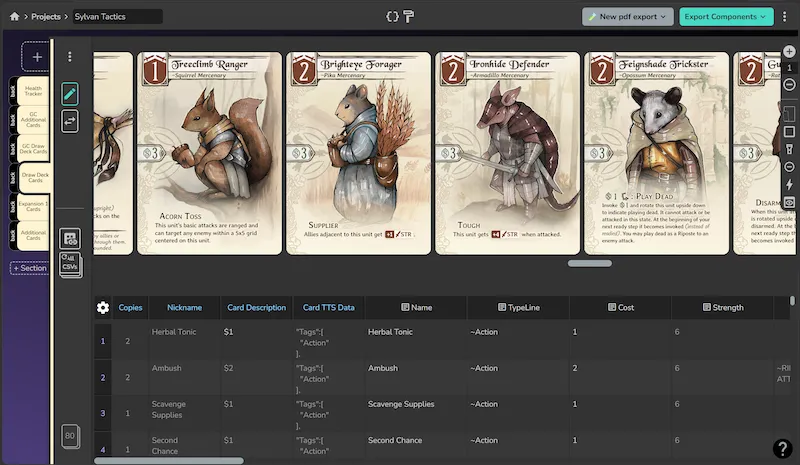
After I have all the scanned art elements I begin working on a unified art layout where I do color grading and minor digital editing in Photoshop to ensure that the original featured artwork and the background watercolor images flow nicely into one another. This all gets merged into a single background image and imported into Dextrous for the final card layout.
At that point, the card is basically finished. Because we’ve already done the hard part of designing the dynamic frames and other content that fills in the rest of the card from our data spreadsheet. From then on we only need to modify stats or card text in the spreadsheet and Dextrous updates the card for us automatically. It has made our editing and balancing process so smooth.
Gil: Ah wow this sounds like a very well-oiled machine. I had not realised the illustrations and backgrounds were by different artists. They look absolutely seamless to me. Also, how cool that you get to work with your wife!
It has been a lot of work, but so much fun!
Gil: It’s great to hear Dextrous has smoothened your editing and balancing process. What does your playtesting process look like exactly? How do you decide what changes to make? When will you know the game is done?
Tyler: I think we have hit over 140 playtests at this point. In a game like Sylvan Tactics, it’s all about getting as much playtesting time as possible. Because there are so many different combinations of cards, it’s almost impossible to predict which strategies will be overpowered or dominant. I actually wrote up a blog post a while back that covers some of my balancing process in more detail. We playtest on our Discord server every other Monday night and I go to local conventions and game stores as often as I can.
I honestly have no idea how to know when the game is “done”, but it has been satisfying to see the feedback slowly evolve from “You should change X, Y, and Z” to “This is so much fun! I love the rabbit character!” So I think we are getting close. When the critical feedback really starts to dry up I think that’s a good indicator that we are nearing the finish line. But of course, I’m looking forward to designing more cards for expansions. Maybe we will never truly finish!
Gil: That’s a decent chunk of testing right there! Ok fantastic so if someone is keen to try the game out now, can they join your Discord server? That’s a good point about the feedback changing as a good indicator of completion. I think when you start hearing ‘Let’s play that again’ you must be super close to done. From a gameplay perspective, what was the change you made to the gameplay that had the biggest impact on playtesters’ experience of fun in the game do you think?
Tyler: Yes, joining our Discord is the best way to get involved and start playtesting. We have players testing the digital version that will be free-to-play on Steam before the release of the physical version.
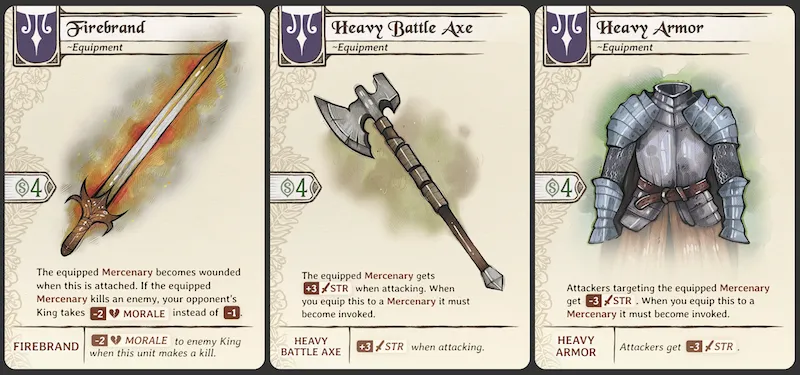
Early in development we had tried to introduce more drastic changes that would separate Sylvan Tactics from chess, but what we discovered was that there is a reason that chess has survived for hundreds of years: It’s extremely well-tuned. We tried reducing the number of pawns on the board and making them redeployable, but in the end we realized that the classic line of pawns in your second rank was key for the evolution of positioning within a single game. You also can no longer redeploy them, which makes games more climactic with proper board attrition. I posted another blog article that details these decisions in more depth for anyone interested. Since those changes it has mostly been a series of smaller balance changes with the costs of various cards and their unique abilities.
Gil: Ok fantastic we’ll check out the discord and that blog post. So one last question before the lightning round. Would you say now Sylvan Tactics is preserving the spirit of Chess or more offering some fresh new experiences in the chess universe? Or something else? What makes this game popular with players and keeps them coming back?
Tyler: I never really set out to design a chess variant. I really just wanted to reuse the board and pieces for a different game, but I realized pretty early on that “chess + cards” was an easy marketing hook. I started applying more and more design lessons from chess to Sylvan Tactics and now the game is much better for it. The biggest discovery we made was that the cards serve as this really exciting skill-leveler for chess.
I’m not actually much of a chess player. I’ve always felt that if I’m playing against someone really good that I’m pretty much guaranteed to lose. And if I’m playing against someone worse than me I feel pretty confident that I’m going to win. It doesn’t hold much drama or excitement for me personally. It feels more like a competitive sport than a game. In Sylvan Tactics we can smooth out that skill curve with hidden information in the form of cards in the player’s hands. It doesn’t matter how many openings you’ve memorized or how far ahead you can predict your opponent’s moves. There are decisions and actions that your opponent can make with the cards that are almost completely hidden to you. This results in experienced chess players needing to play more conservatively and novice chess players feeling more emboldened to be aggressive. And mistakes are not as punishing since you can redeploy your pieces throughout the game. I’ve actually lost Sylvan Tactics against one player who had never played chess before!
The number and variety of cards also results in games that feel fresh every time. I’m still seeing playtesters discover new strategies that I’ve never seen. Multiple players have told me they might finally get some use out of their chess boards, which has been so gratifying. I don’t think Sylvan Tactics will still be around in hundreds of years like chess will, but I do think there are lots of players who will find a ton of really delightful novelty in the game.
Gil: That’s a really cool point of difference too, to shift the focus to something with more drama and excitement. The fact that this also is a skill-leveler is pretty awesome. Although I do love chess in the abstract (I admire it’s design) I have exactly the same problems with it that you’ve described, so I can totally see Sylvan Tactics being a breath of fresh air to the chess space. Now it's time for the lightning round!
⚡⚡⚡ LIGHTNING ROUND! ⚡⚡⚡
What is your favourite game mechanic and why - in a sentence!
Card-based randomizers instead of using dice, etc. Gloomhaven does this really well.
What is your favourite animal from Sylvan Tactics?
Gotta be the frog. He just looks so hilariously out of place compared to the majority-mammal cast.
What’s the best piece of design advice you’ve ever heard?
Keep removing things until you find something that is so critical to the game that it would cease to be the game without it. Less is more.
What do you think is the most overrated mechanic in games today?
I’m tired of the component bloat. I don’t need a shelf full of miniatures. I want well-designed mechanics, not glorified collectibles.
Luck vs skill, what’s your take?
Luck is a lot like comedy. It’s amazing when you can time it correctly. Surprise is such a useful tool, but if everything is “surprising”, then nothing is. Sprinkle some luck in your games.
What’s the longest game you’ll actually play?
A four player game of commander in Magic: The Gathering…
Do you sleeve your own games?
Nope, but only because I don’t play any one game heavily enough to need it.
Favourite colour to put on a board — no justification allowed?
Purple.
If a cat walked across your prototype in the middle of a playtest, is it a sign or a setback?
I’m allergic, so a setback…
If your game was a weather event, what would it be?
A dust devil. Exciting, fleeting, memorable. The kind of thing that feels danger-adjacent. Just enough to make you want to get closer and check it out.
Gil: Amazing answers there, that was fun. Just before we close, where should people to go see what you're working on?
Tyler: Come join us on the discord. Playtesting happens every other Monday. I'd love to hear what you think!
You can also wishlist and follow the digital version on Steam.
Gil: Thanks so much for joining me Tyler, it’s been awesome having you and I can’t wait to check out Sylvan tactics.
Tyler: This has been great! Thanks for letting me nerd-out!