Climbing Mountains in Game Design
Gil: Hey Zach, and welcome to the Dextrous Designer spotlight! Can you introduce yourself and your very cool looking game?
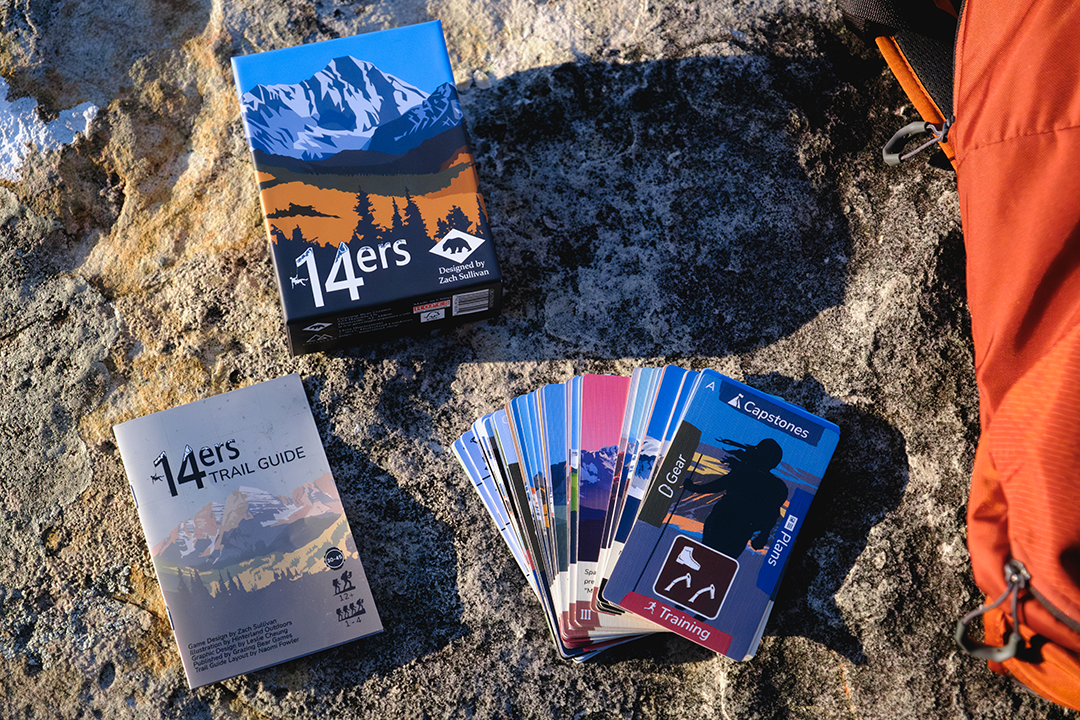
Zach: Hi Gil, thanks so much for having me! I'm a husband, dad, game creator and lover of the outdoors based in Huntsville, Alabama who runs the company Grazing Bear Games. Our next upcoming game is "14ers," named for the mountain peaks in Colorado that reach over 14,000 feet high. It's a quick tableau-building game for 1-4 players where players use different attributes in their tableau to gain Climb cards, each representing a unique peak over 14,000 feet (a "14er"), and then tuck that Climb card under one of the four sides of their tableau to gain new abilities or points.
Gil: Ok this sounds very fun already. Love the theme! Can you unpack that a little more for our readers?
Zach: Lots of hikers go for the views and exercise, but many mountaineers are more interested in the challenge and accomplishment of going higher and farther than most people to reach the very top. The highest peaks in the 48 contiguous United States top out between 14,000 feet (4,267 meters) and 15,000 feet (4,572 meters), and all of them are located in only 3 states: Washington has two 14ers, California has twelve, and Colorado has between 53 and 58 (how you count them depends on a few different factors like prominence or how far it stands out above the surrounding area, distance to the nearest peak, and more). Since Colorado has a very adventurous populace and so many 14ers, it’s become a popular challenge in the mountaineering community to summit as many 14ers as you can - and some extreme athletes even race to top all of them in the shortest amount of time (Andrew Hamilton set the record at 9 days, 21 hours, and 51 minutes in 2015).
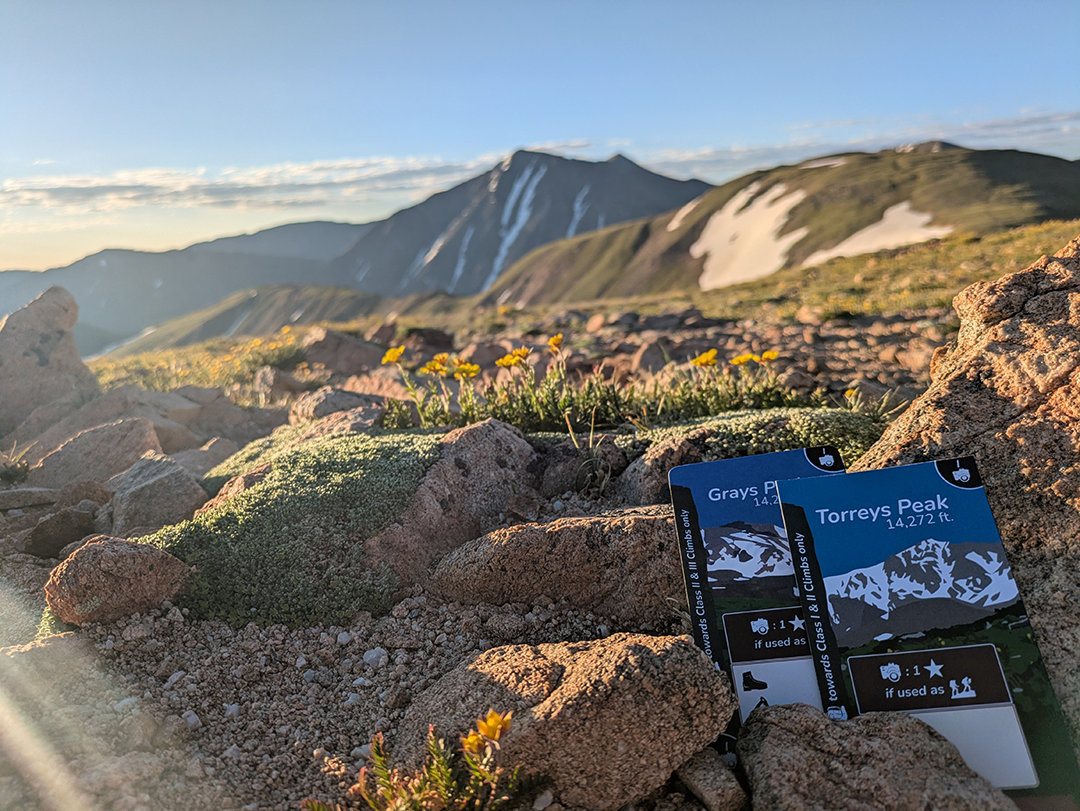
On the other hand, normal folks like me just get intoxicated by the views, pride, connection to the natural world and detachment from civilization that you get at 14,000 feet, and have no delusions of being a speed athlete but still love the adventure. If you ask around at most places in Colorado, someone there has stories of some sort about the 14ers, and many towns lie entirely in the shadow of these majestic mountains.
Gil: This is fascinating. Coming from Australia we simply don’t have mountains of this scale, so I can understand the appeal of scaling these giants. It’s wild that whole towns lie entirely in their shadows too. It sounds very much like you have a theme-first approach to the design which sounds very immersive. Now you mentioned this is a tableau-building game and there’s some ‘tucking’ going on. What exactly does that mean?
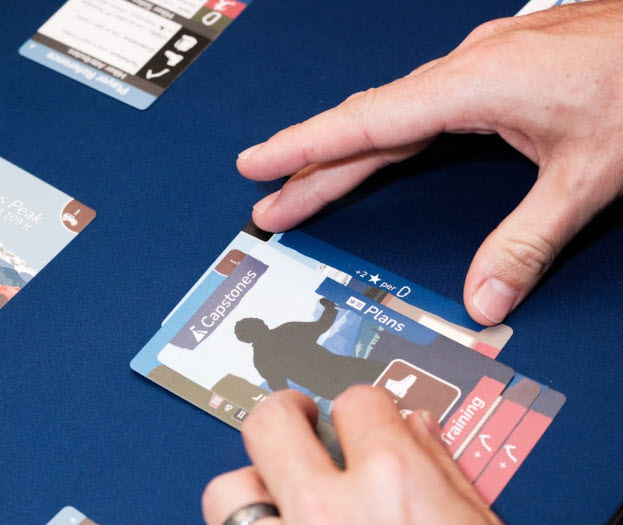
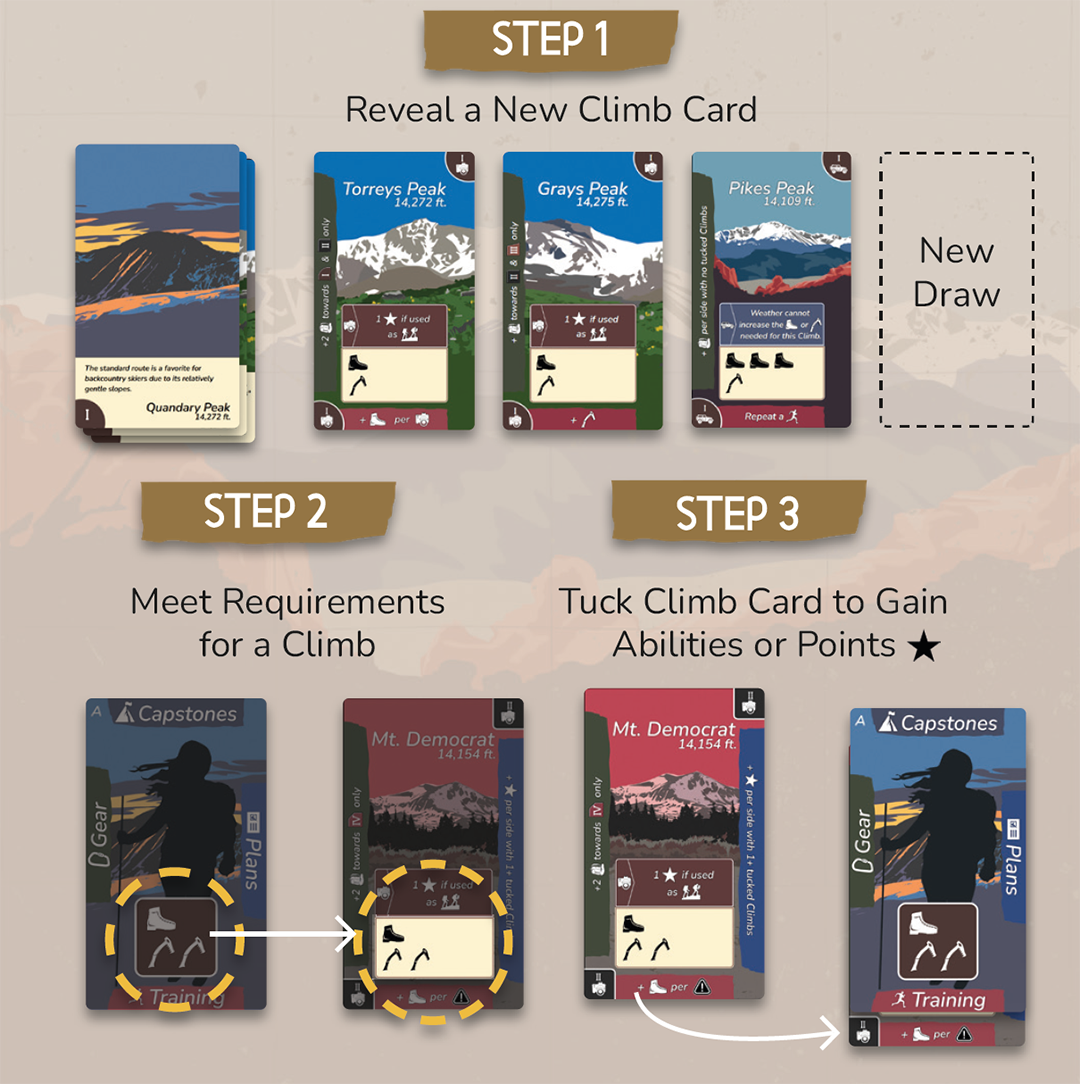
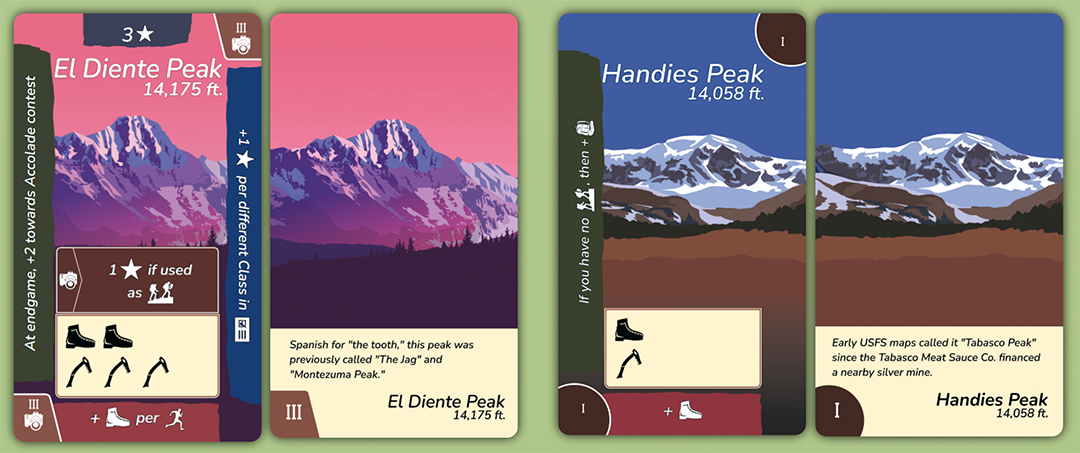
Zach: A tableau-building game usually involves arranging cards and/or other pieces in a personal display to increase your abilities and/or points. Wingspan, Terraforming Mars, 7 Wonders, Everdell, and many other popular games feature tableau-building. In 14ers, you play as a hiker in Colorado, and the core loop of the game involves using your core attributes of Endurance, Technique, and Utility to meet the requirements of a Climb card (representing a unique 14er), then tuck that card under your Hiker card to reveal a new benefit that card now adds to your Hiker (either the ability to conquer more difficult Climbs, or more points at the end of the game). You can tuck the card by sliding it directly on the playing surface underneath your Hiker card and any other Climb cards that might already be there, but leaving an edge exposed that has a new ability for your Hiker to use. As you tuck more cards and gain more benefits, you will build your “tableau” as your Hiker gets stronger and better equipped to summit the toughest peaks.
Gil: Ok I get it, so you’ve got a kind of set of cards centered around a hiker that you’re upgrading as you go. And how does this mechanic capture a sense of climbing?
Zach: All of this relates to the theme of climbing by centering around the idea of learning and growing as you go. Each 14er has one climbing route known as the “standard route” that is usually the safest and most-traveled path up to the summit; these routes are listed and organized into different classes using the Yosemite Decimal System of 1-5, and new hikers are recommended to start with the Class 1 routes and work their way up to the Class 4 routes (the highest the standard routes get on Colorado 14ers).
We tried to mimic that sense of growth and progress with the central loop of the game, where each Climb card is a challenge on its own but also contributes to making you a better Hiker after you complete it. The different sides of the Hiker have thematic names to tie it in further: if you tuck a Climb as Gear or Training, they help you summit more difficult Climbs in the rest of the game, while tucking it as Plans or Capstones represents your achievements as an outdoor athlete and give you points at game end.
Gil: Ok this sounds like a very solid core loop. That whole idea of overcoming challenges reminds me of that saying: ‘what doesn’t kill you makes you stronger’. Sounds satisfying to play at least! Speaking of overcoming challenges, I want to dig into your journey as a designer more. What were some of the biggest mountains you had to climb in prototyping and producing this game?
Zach: Sure! Two of the biggest challenges that spring to mind are balancing all the different abilities in the game and “signposting” to players hints about different options and strategies.
There are over 80 different abilities or scoring options on the different sides of the Climb cards, so balancing them involved a lot of math and a lot of trial and error of even more potential abilities. However, I found that even more important than actual balance is the perception of balance: most players won’t play the game enough times to see all the different possibilities, so how do you make sure as many players as possible feel that they have multiple viable options on each turn, and a fair chance to win no matter what cards are drawn?
This took a lot of testing with over a hundred different players to see how different gamers evaluate the relative strength of different abilities, and sometimes just A/B testing different numbers or wording on those abilities to see how things “feel” to players and how they actually play out in most games. There were a lot of spreadsheets involved, and lots of notes from many different playtests, but Google Docs made that documentation pretty easy, and Dextrous makes it very easy to implement and test those different tweaks.
Gil: Got it. So it sounds like your prototyping and tweaking with a whole range of players was pretty key. So you’ve balanced the math so that players have access to these multiple paths exist in the game, but you mentioned the other challenge was about ‘signposting’ these options in a clear way to players. Can you tell me more about that?
Zach: The other big challenge was communicating with players through the game components in such a way that encourages them to experiment and discover new synergies and strategies. As a designer, you often want to just tell people, “Grab that card! Choose that option! It’ll be super cool, trust me!” - but the far better process is for you to just watch what people discover on their own so you understand what players are thinking and how you can meet them there.
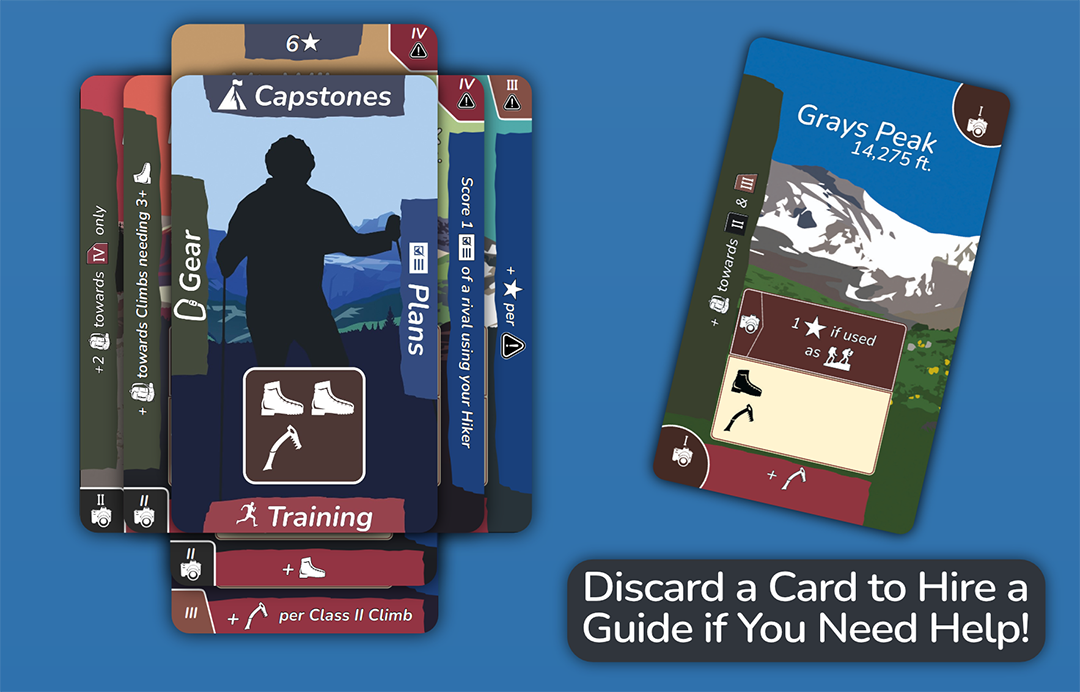
As an example, in 14ers you have the option of discarding a card from your tableau to help you ignore a requirement you don’t meet for a new card you want (this is called “hiring a guide”). This is both a failsafe so that players can always move forward each round, and an alternate strategy for playing the game that multiple abilities interact with and may give you more points for hiring more guides. However, lots of players resist using this option because discarding a card from your tableau may lose you some progress/points and it might feel bad if you weren’t planning on it. To help ameliorate this, we made some cards score a point if you discard them, and built in some abilities that are powerful in the early/mid game but usually worthless in the late game so that you have easy targets to use for your discards, and might get the idea earlier to plan out which card you might discard.
Gil: Ok that’s cool. I like the idea of building in a failsafe and some appealing early/mid game options might pull players in different directions. It makes me want to play! So now that you’ve finished the design, do you have any advice for other designers making tableau builders in this space?
Zach: My advice to other designers creating tableau builders would be the same as my advice to all new designers: start simple and grow from there. For tableau builders, this applies to both your overall structure of the game and the individual options players can add to their tableaus.
Note that games like Wingspan, 7 Wonders, Forest Shuffle, and many others have incredibly simple turn structures (do one of a few simple actions, play one card, etc.). This helps players get through the initial “teach” of the game very quickly, and makes the first few turns very accessible. This also provides a strong foundation for most of the tension and interesting decisions to come as a direct result of player actions, which always feels more fair and interactive. After you’ve narrowed the core loop down to its purest form and confirmed that it’s fun and works well, then you can go back and add one or two alternate options such as chaining free buildings in 7 Wonders, discarding your hand to draw more cards, or hiring a guide in 14ers like I mentioned above.
Keeping the options simple for the cards/tiles/whatever you’re adding to your tableau is the best way to start, but later on you can add some wacky and wild fun options. Early on, you should be focused on the core mechanisms and feel of the game, so you want most or all of the variable options and effects in the game to be pretty simple so you can clearly see and evaluate the central structure. Once you’ve mostly locked in the central loop of the game, then you can add some fun options that change up the game a bit more.
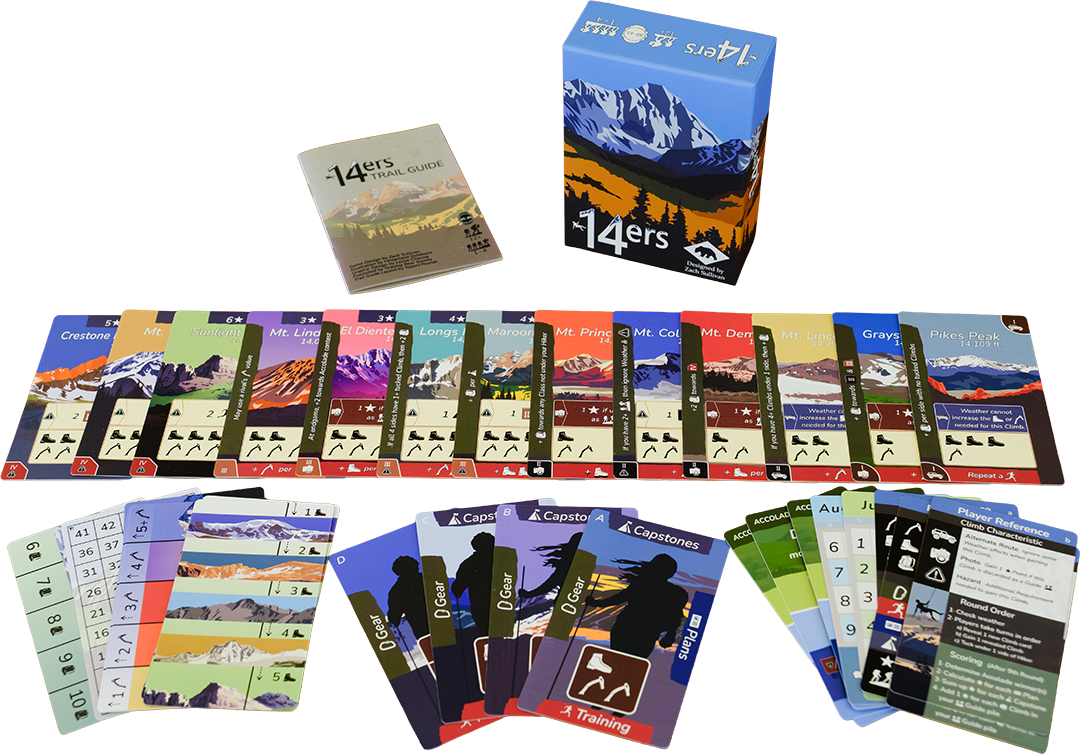
However, you should keep a lot of those simple abilities in the game as a baseline for players to more easily evaluate and compare their options on a turn (most tableau builders have at least a few cards that are basically “gain one resource”); you can even make those options that players access earlier in the game to help facilitate a gradual ramp in complexity and easier learning for new players.
Gil: Excellent advice. I like the focus here on nailing a compelling core loop first and foremost, and then branching out once that’s solidified. In the branching out phase of your design, how do you come up with interesting new mechanics and combos? Do you have any process for coming up with new ideas and sifting the good ones from the bad?
Zach: Oh man, I’m always coming up with new ideas - I keep a running Google Doc on my phone for new ideas about stuff I can put in my game, and I add to it all the time! Walking the dogs, watching TV, trying to fall asleep, whenever an idea pops up I try to write it down quickly until I get a few together to try out. Occasionally these may come in groups together that represent a combo or overarching strategy I’d like to try, but usually they are individual abilities that stand on their own, and then the synergies appear on their own as each option interacts with the core systems of the game.
Sometimes you can tell just by thinking out a few turns of a certain ability if it’s a good one or not, and sometimes you can quickly identify it as being too complicated for most players, but the best way to sift good ideas from the bad is with lots of playtesting! Exporting cards from Dextrous to Tabletop Simulator or screentop.gg is a very fast way to do a solo playtest just to see how things play out, then I’ll print out and cut the cards to do some playtests with my family, local playtest group, at the next convention I attend, or with other friends. Getting reactions and feedback from a variety of other people is the best way to know which ideas are worth keeping in the game, and sometimes they have even better ideas about new mechanics, combos, and more.
Gil: Yeah I’ve started doing the same notebook thing. It’s so helpful to have ideas in one place for sure. And I like that advice about testing a new mechanic digitally quickly and then if it holds up, getting it to the table for closer inspection and reactions from playtesters. Speaking of reactions, what reaction/experience are you most excited to see people engage with in 14ers?
Zach: Like most designers, I’m just happy when people enjoy the game and have fun, but there are two other emotions I love to see: the “a-ha” moment of realization when the game’s mechanics really click for a player, and the spark of curiosity when someone learns a cool fact about the incredible mountains depicted in 14ers and is inspired to go research more and maybe even plan their own adventure.
I love seeing people learn and appreciate both the systems of the game and the real geography it is based on, and I’m really excited for more people to share those magical moments with their friends and family when they have their own copy of 14ers.
Gil: Wow yes I can imagine how satisfying that must be - to share your love of these mountains and climbing and have that fire ignite in the player’s mind. Climbing is not something I’m super familiar with, but this conversation has definitely piqued my interest, and I can’t wait to play 14ers. So to finish with, tell me, where can people get in touch with you Zach? And how can people get their hands on this game?!
Zach: I run all the social media accounts for Grazing Bear Games, so feel free to message me on our Facebook or Instagram accounts or you can always email me at info@grazingbeargames.com.
You can secure a copy of 14ers for just $20 at our Kickstarter page here! Note that we’re only shipping copies to the US and Canada right now since we’re a small and new-ish operation, but we do have a Print-and-Play option available worldwide for only $6.
Thanks so much for having me Gil, and thanks to everyone for reading this far! Best of luck in all your game creation efforts!
Gil: Thanks so much for joining me Zach, and all the best with the Kickstarter!