Simplicity meets Speed in Courage and Cunning
Gil: Today we have Sal from Fountain Mouse Games joining us.
Welcome to the Designer spotlight Sal! Let’s start simple. How did you get into game design, and what project/s are you working on now?
Sal: Hey Gil! I’m so glad to have this opportunity to talk to you.
I’ve been designing games since I was a kid, when I forced my little brother to play a homemade RPG with me (I wasn’t old enough for D&D yet). Over the years I’ve cycled through many hobbies, but games have been a mainstay. I’ve gotten serious about game design recently, having spent over a year developing various projects for Fountain Mouse Games.
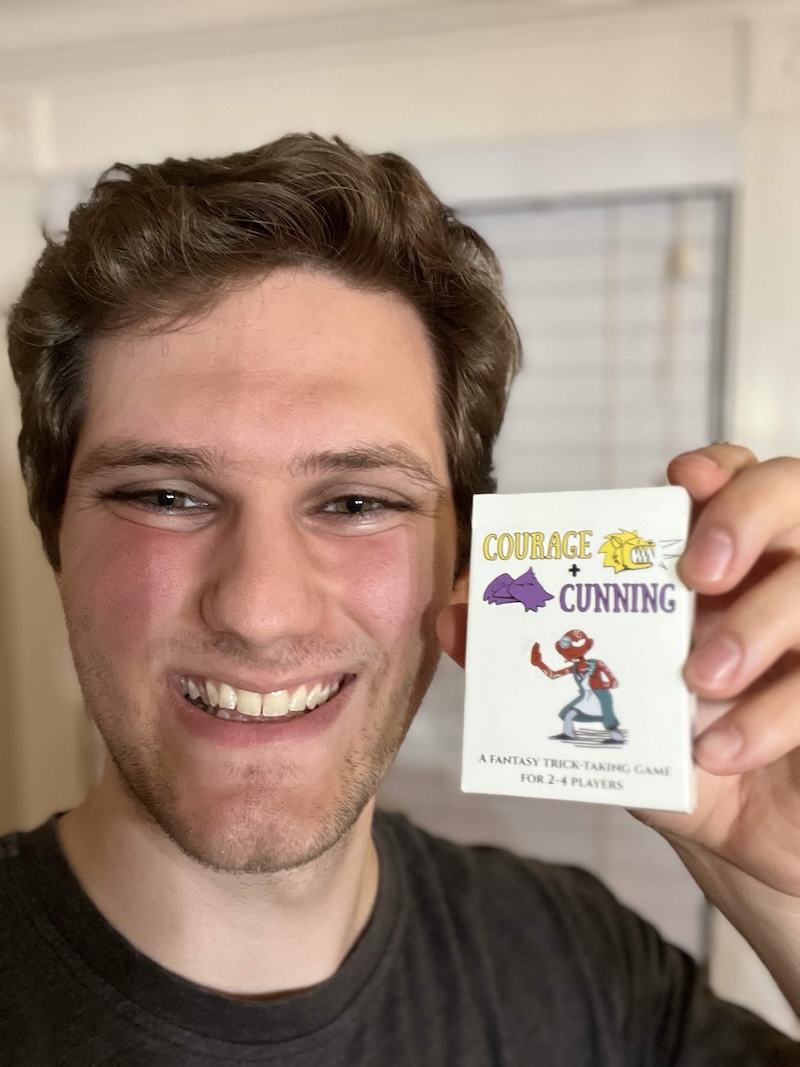
Currently, I’m focused on the Courage and Cunning campaign, and so far it’s outperforming all my expectations! I’m really excited about the community’s enthusiasm and support, and I can’t wait to see what heroes they make for the stretch goals. Who knew this little trick taker could take off like it was on rocket skates? 😉
Other than that, real ones know about a little game project called Interdict that has been in development for well over a year. A deckbuilder with our own unique twists where players are scrambling for the best combos and synergies as they grow their mafia empire. And the art style is super fun — think old cartoons like Cuphead. The game is finished, as far as design, but we’re still working on art, graphics, and a Kickstarter page. It’s a larger game than Courage and Cunning, so there’s a bit more that needs to happen before we launch it.
Gil: Sounds like you’ve got a rich history with game design Sal, and now you’re launching yourself into the industry in style with Courage and Cunning! So tell me more about Courage and Cunning - how did you come up with the idea, and how did you know it was worth pursuing all the way to publishing?
Sal: My co-founder (Johnathan) and I were discussing the slow pace on Interdict development when I had an idea. What if we made a super small game that was easy to distribute as a print and play? Then, we could run a smaller Kickstarter campaign, get some experience, and get a game into people’s hands.
He came back with the initial concept for the game, and together we workshopped it, sending ideas back and forth, playtesting, and even meeting up in-person for a playtest session where we really ironed out the kinks of the core gameplay loop. We weren’t going to launch a game we weren’t absolutely thrilled with.
After much refining, we ended up with the game as it is today. Then, we thought about a hero pack expansion, as that had been an idea early on that we scrapped but still loved. With some tinkering, we got the heroes into amazing shape, and now we can’t imagine the game without them.
There’s a moment during playtesting with new players where they tell me their initial impressions and then I ask: “Do you want to see the hero expansion?” As they read the heroes, something clicks in their mind, and they quickly gravitate towards a favorite hero. That moment of discovery and pure fun as they use the hero abilities to bend game rules is such a joy for me to watch.
Gil: This sounds so great. Sometimes these smaller projects pack an oversized punch too, because in a way, your designer-mind is freed from having to jam everything into the one game. So tell me about the core loop of Courage and Cunning - what are you proud of? How did you get it so smooth? And how do the Heroes play into that experience and bend the rules exactly?
Sal: I’m proud of the back-and-forth between players. Each game mechanic adds a layer of depth to this player exchange. Early on, we lacked the texture and balance that these mechanics provide, but as we added them the game began to smooth out and feel great to play.
For those unfamiliar with the game, Courage and Cunning is a trick-taking game for 2-4 players where you compete for loot cards.
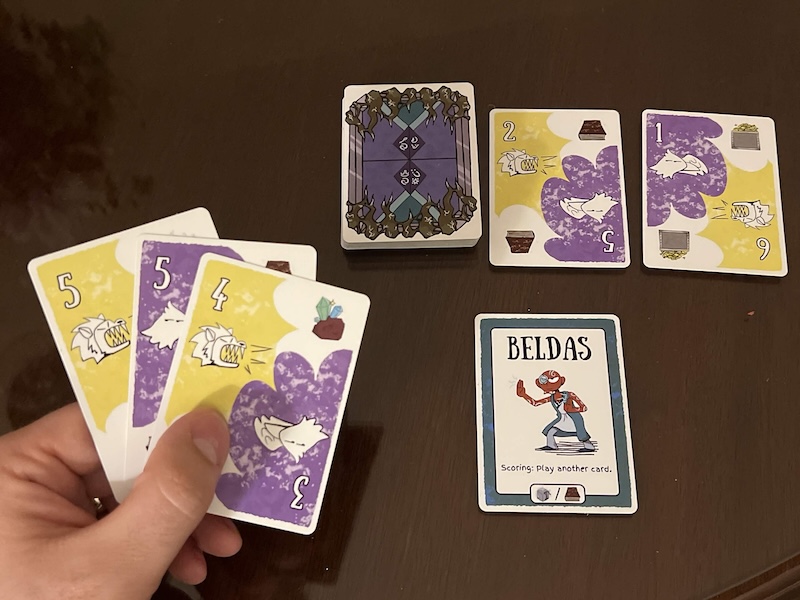
Each round, players play one or more cards from their hand, but they start with six cards and that’s it. You must manage your cards carefully!
Each card has two numbers: one for Courage and one for Cunning. The player with the highest number in either attribute wins a loot card, and they discard whatever card(s) they played. Losers get their card(s) back, which is a brilliant catch up mechanic (thank you Johnathan) that adds a lot of extra depth to the game.
Timing your plays for when it really matters is a huge part of strategy. Every loot card is worth 1 point, unless you get a matching pair of loot cards which is then worth 2 each (4 total). Completing a pair is often a satisfying, game-winning play!
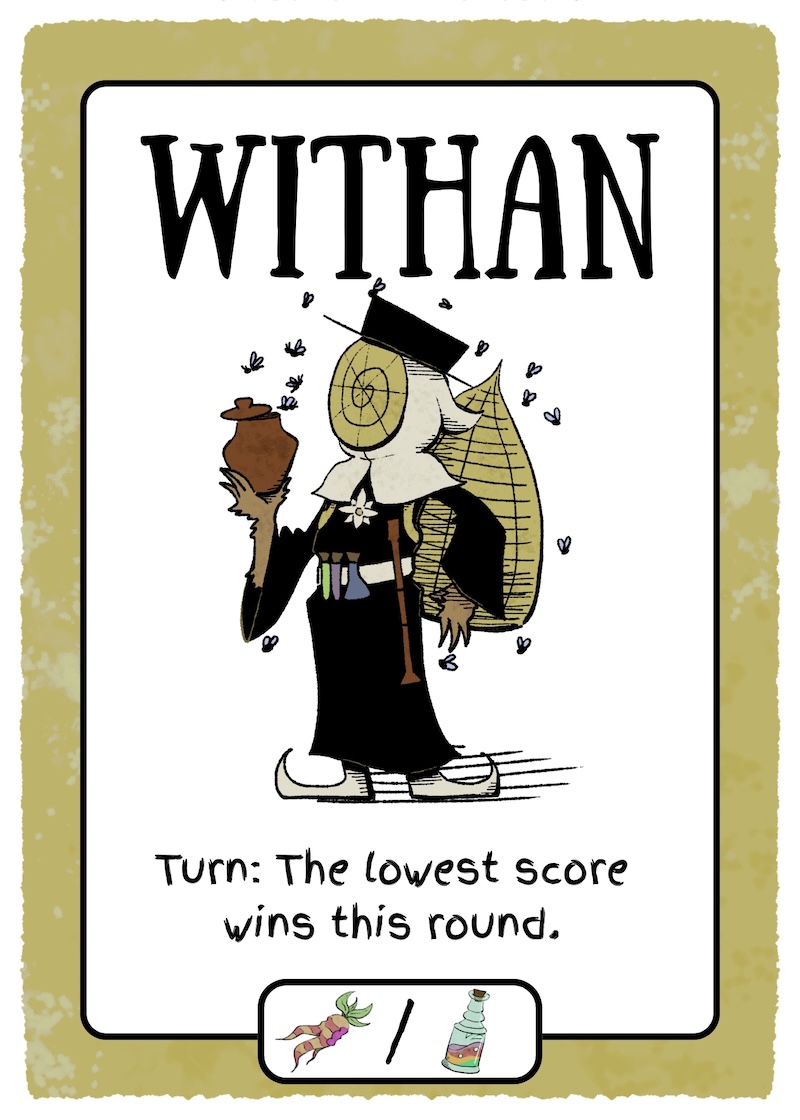
And finally, the heroes each have scoring symbols that add 1 point per matching loot card, which adds another layer. Each hero also has a unique, once-per-game ability that can turn the tide of the round in your favor. Timing these abilities is one of the most fun parts of the game, in my opinion. Take Whithan for example, who makes it so the lower score wins the round. Nothing feels better than using his ability to snag a loot card you had no business winning!
Gil: Ok cool so it’s kind of set collection meets bidding meets bluffing? This sounds nice and simple to learn but I can imagine it gets pretty tense and deep when you factor in predicting your opponents’ moves and the hero ability interactions. Speaking of the heroes, I LOVE the art for these guys - so much fun characterisation in the style here. Let’s dig into the theme and worldbuilding a bit more. How did you go about crafting the story world and the thematic art direction for this game and the heroes in particular?
Sal: Johnathan and I have a long history of collaborating. In college, we would meet up for a variety of things — worldbuilding sessions, writing sprints, and brainstorming ideas. Some fun callbacks to those sessions made it into the game.
Otherwise, this game has been an experiment of fusing together some of our favorite tropes from Fantasy, Sci-fi, and other genres into something that’s super fun, but also hides secrets beneath the surface for players to discover.
We’ve got our art direction process down to a science by now. After spending time brainstorming the overall world, we land on some core aspects and themes and begin crafting the individual art briefs. One of us drafts an initial art brief for a character, then the other reviews it and makes edits, then we send it to our artist for sketches. Rarely do we have to do multiple rounds of art brief revisions — we’re pretty in sync these days.
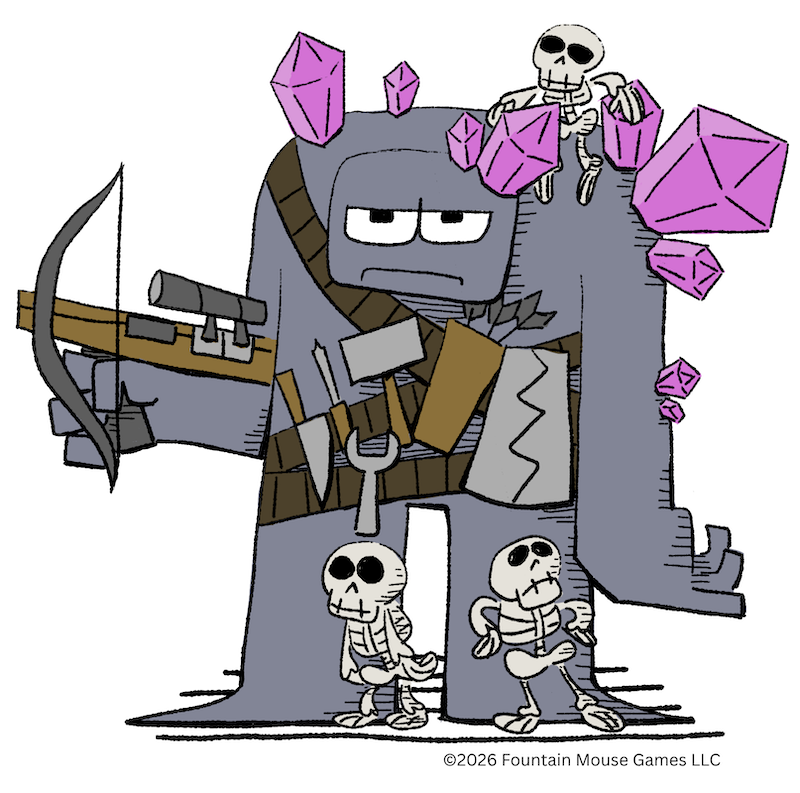
One of my favorite contributions to the art direction has got to be the Bonelins. They’re the little skeleton goblin dudes hanging out with Kolg, much to his dismay. I find them to be incredibly funny and entertaining any time I see them. Their origin and purpose is… well, it’s certainly a fascinating secret to discover, and perhaps players can learn more about the bonelins in the story mode expansion…
Gil: Oooh easter eggs! Ok now we need to see that story mode expansion ha. Speaking of which, what made you decide to go with a story mode expansion rather than put that content in the main game? It’s a common question for designers I’ve found - how do you choose what is ‘core’ and what is ‘extra’?
Sal: That’s a great question! The story mode is a literal book, about the size and length of a novella. So, when your core game fits into a poker-deck tuck box, it makes a lot of sense to offer the story mode as a separate expansion.
When it comes to core VS extra, in my mind it boils down to what is essential to gameplay. For example, the Heroes of Cax expansion rides the line. You don’t need it to play the game, but it adds a lot of depth to the core experience, so it became an “included expansion” which is designer speak for “an extra way to play.”
Gil: That’s a really good way to put it. And I can see the appeal of keeping that core experience super small and portable too and then offering something more deluxe for the fans. Ok one final question before the lightning round: What was your most important design lesson from Courage and Cunning that you’ll take with you for future designs?
Sal: There’s an acronym, and I can’t remember where it comes from, called K.I.S.S. which stands for Keep It Simple, Stupid. This project we’ve had repeated applications of that mantra over and over, at every step. For every design challenge you face, there is a simple solution. It might take you time, effort, and manic brainstorming sessions to figure out, but it’s there.
For example, when designing our hero abilities, we initially had some doozies with bizarre timing restrictions and even stranger effects. We had to ask ourselves which abilities were easy to understand, use, and added to the game experience, and which abilities were just plain confusing. In the end, the simpler abilities proved much more interesting. Turns out that players have more fun when they can easily understand what’s going on!
Gil: Love this advice Sal, it’s super inspiring to us designers who are always tempted to add more. Often less is more. And speaking of less being more, it’s time for the lightning round! Let’s go!
⚡⚡⚡ LIGHTNING ROUND! ⚡⚡⚡
If you could add one rule to Monopoly, what's would your rule be?
The game ends after each player makes two full circuits of the board.
What's the most dramatic thing that's ever happened at your playtest table?
One time, while testing an early version of Interdict, I found a nearly infinite combo that let me draw my entire deck and gain points for every card I drew… yeah we removed that real quick.
Hot take: Which game mechanic are you a bit over at this point in time?
The unnecessary one. You don’t need it. Come on, just cut it from the game.
In one sentence, describe the moment you knew you were a game designer…
“Hey, Sal… do you want to start a board game publishing company with me?”
If you had to hide a secret message in a rulebook, where would you put it?
In plain sight. 😮
What is your favourite colour to put on a board?
Crisp, black lines.
What is the coolest game idea you’ve had that you don’t have the skill to pull off yet?
I have this idea for a 1v1 asymmetric fighting card game, with individual heroes and decks. It’s basically Super Smash Bros, but as a trading card game minus the random booster packs.
What animal would make the best playtester for your games?
A cocaine panther.
In your opinion, what's the most cursed game component that ever existed?
Thin punch-out tokens. They are IMPOSSIBLE to pick up off the table without damaging them. Make them thicker, or stop making them, PLEASE.
Gil: Thanks for that Sal! Now where can people go to find Courage and Cunning, and is there anything they should know about the campaign? And where can people check out your other projects too?
Sal: You can find Courage and Cunning live on Kickstarter right now! The campaign ends June 9th, but don’t wait. We’re running community polls to decide the next two heroes to add to the game. You can even submit your own ideas!
For all future projects, you can go to FountainMouseGames.com and click on the “games” page. We have an email newsletter you can sign up for if you want monthly updates.
We also have a pretty active Discord server where you can discuss games you’re playing, see preview content of our games, and generally have a good time with fellow gamer nerds.
Thank you for the interview, Gil, it was a total blast!
…
I play a 6 Courage. Your move.
Gil: Thanks so much for joining Sal - until next time!